- Open Today: 10.00–20.00
- Ticket
- Shop
- Membership
- TR EN
Erol Akyavaş, 1932-1999
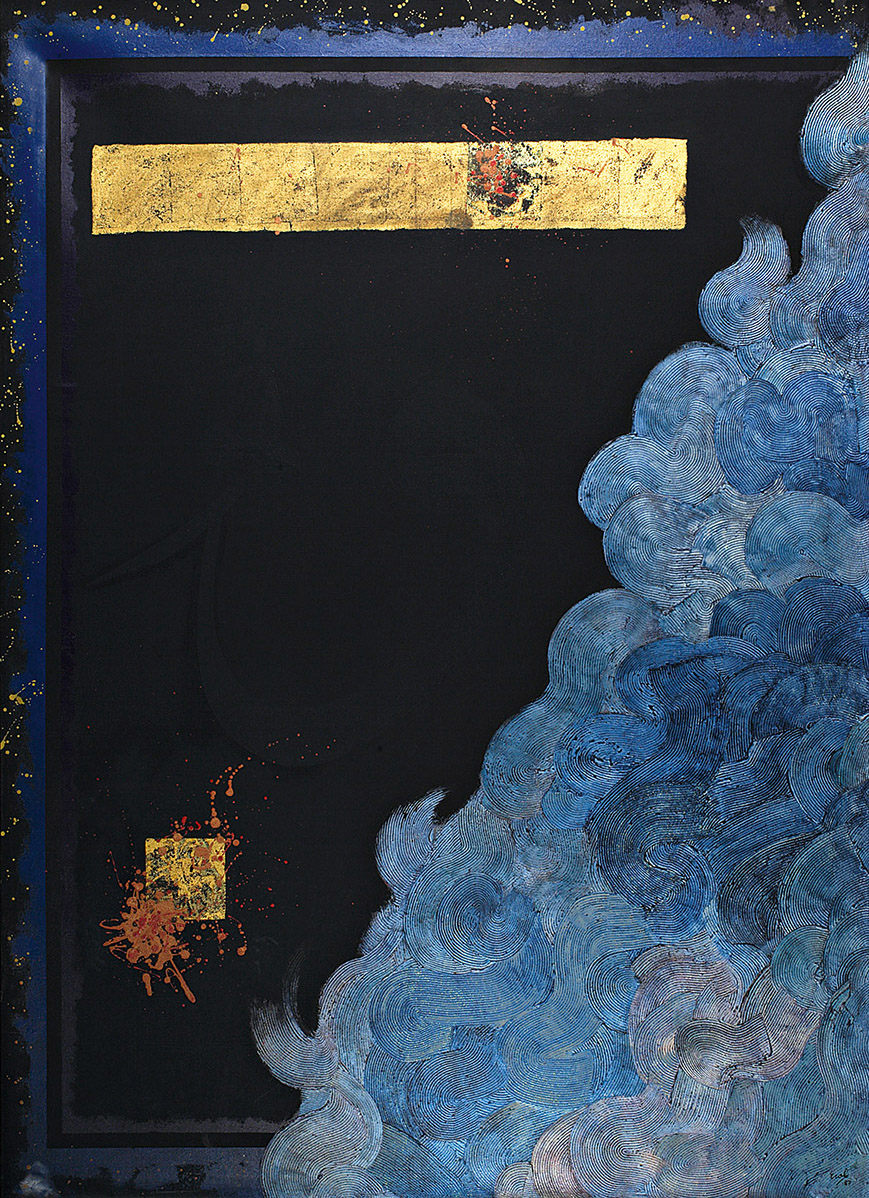
Mansur Al-Hallaj, 1987
Born in Ankara in 1932, Erol Akyavaş dropped out of his studies at the Faculty of Political Science at Ankara University, after which he attended classes as a guest student in the studio of Bedri Rahmi Eyüboğlu at the Fine Arts Academy in Istanbul and took part in its exhibitions. He attended summer classes at the Accademia di Belle Arti di Firenze, and worked with André Lhote and Fernand Léger in Paris. From 1954 to 1960, Akyavaş studied architecture under Mies van der Rohe at the Illinois Institute of Technology in Chicago, where he had initially intended to study aesthetics and the philosophy of art. He then worked in the office of Eero Saarinen while simultaneously continuing his artistic pursuits. After operating in the field of architecture for some time, he decided to leave; it did not offer him what he was seeking, either in theory or in practice.
Akyavaş is a well-known figure in Turkish painting whose work encompasses traditional Islamic thought and has mystical overtones. He is rare in having managed to create an original synthesis of Western rationalism and Eastern worldviews. In the 1960s, Akyavaş began using religious symbols in his work, as in his “Karbala”, “Mansur Al-Hallaj”, “Miracname”, and “An Al-Haq” series, which combine calligraphy, the urban and architectural forms of miniatures, and religious stories. He also interpreted in a modern visual language words and letters from the old Ottoman script such as elif, lam elif, and vav. For instance, one painting from the “Mansur Al-Hallaj” series has almost its entire surface covered with the letter vav, thereby forefronting the symbolic value and meaning of the letter rather than its legibility. In Islamic mysticism this letter symbolizes the relationship between the creator and the created—an idea of oneness between humankind, the universe, and God as preached by the Persian mystic Mansur Al-Hallaj, who lived at the turn of the ninth to the tenth century.
Akyavaş once defined the core of his work as a discovery of “the beautiful and that which pertains to the beautiful” and “the beauty behind what is visible”—the latter a traditional tenet of Islamic thought—as well as a desire to attain “the immutable behind the transitory”. He also emphasized the esoteric aspects of his art. In works based on the Ottoman miniatures of Matrakçı Nasuh, Akyavaş re-created their stylized realism using the geometric language of modern art. He transformed urban constructs into labyrinths using different perspectives, reinterpreting with fresh insight the stylized depictions of nature seen in miniature art.
Painting
Mixed media on canvas
207 x 150 cm
Dr. Nejat F. Eczacıbaşı Foundation Collection
Istanbul Museum of Modern Art / Long term loan