Abidin Elderoğlu, 1901-1974
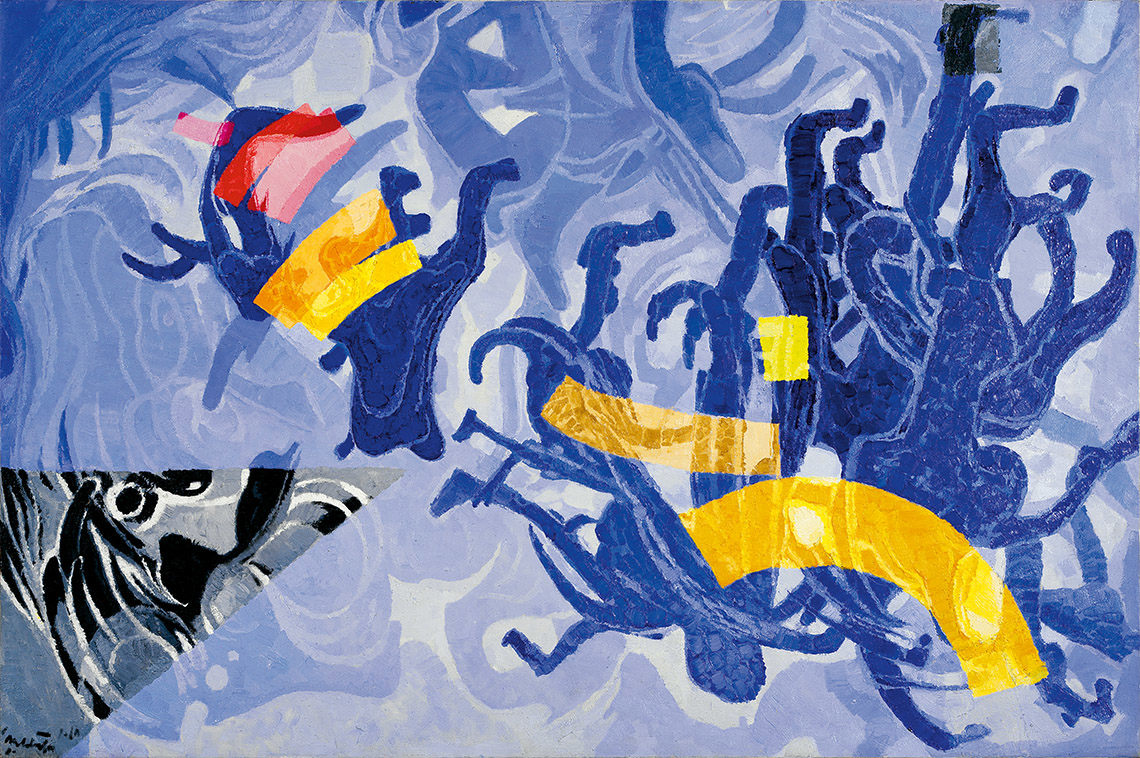
Composition, 1969
Abidin Elderoğlu graduated from the Istanbul Teachers School in 1926 and went to Paris in 1930 to study on a scholarship provided by the Turkish Education Society. There he worked at Académie Julian, initially under Paul Albert Laurens and then under André Lhôte. The latter greatly influenced Elderoğlu to make Symbolist paintings in a semi-Cubist style, informed by mythology.
Elderoğlu took part in the “Homeland Tours” program (1938–44) organized by the Republican People’s Party in 1942 and went to Muş, where he reveled in the luxury of working outdoors. Taking advantage of the light and shadow effects produced by the region’s brilliant sunlight, he discovered how to fuse and create transparent forms. Separating colors into two groups, dark and light, the artist stripped his subjects of all detail, leading to an important breakthrough in his move toward abstraction. He realized it was meaningless to take as one’s starting point the traditional existence of the object to be painted and concluded that one could attain abstraction by a thorough observation and analysis of nature. Works that garnered attention at various international exhibitions in the 1960s were abstract, and concentrated on plastic values such as color, form, line, and light and shadow. Distinguishing between the fundamental concepts of form versus color, the artist transformed his stains of color into forms that reappear in his various paintings.
By the 1960s, Elderoğlu’s inspiration had thoroughly shifted to defining the problem of essence. Founding the existence of his forms on the surface on a contour-based drawing style, the artist created primarily lyrical abstractions. This was in keeping with his avowed aim of achieving a unique language of expression based on both Eastern and Western art. In the text of his last solo exhibition held in 1973, the artist explained the synthesis he wished to achieve: “Aiming to attain the abstract quality of art, I have based my art on the effectiveness of plastic elements such as color, form, lightness, darkness, and semi-darkness, in parallel with how sounds are applied in music according to their function. This is how my art has taken shape. My paintings are for listening with the eye, without being caught up in looking for a reason or subject. … My painting is rooted in the techniques and skills of Asian art, extending all the way to the Far East, while my brushwork is inspired by the vibrancy, lissomness, sensitivity, and richness of European art.”
Painting
Oil on canvas
97 x 146 cm
Dr. Nejat F. Eczacıbaşı Foundation Collection
Istanbul Museum of Modern Art / Long term loan